ADI SHANKARACHARYA

(
This biography was written by a friend of mine who made his honest attempt to summarize the life of this great man. There is much more to Shankaracharya than mere words can do justice to however. Hopefully this will be a starting point to give you insight on one of our greatest philosophers ever!)
Adi Shankaracharya was born in the year 788A.D. during the spring season (Vasanta Ritu) at noon in Abhikit Muhurta under Ardhra which is extremely auspicious moment. He was born in modern day Kochi, Kerala (left), where today stands an ashram. His father Sivaguru passed away when Shankara was only 7 after which point he under went the Upanayana ceremony (janoi) and his mother took over his education to teach him all the Shastra’s and Veds.
EDUCATION:
This was just his initial education, and considered very primary. Like elementary and middle school training. He had everything memorized with understanding by the time he was 16. At this auspicious age he began prasthantraya bhasya. This is when you write commentaries on the Gita, Upanishads of the Vedas, and the Brahma sutras. To do this at this age is extraordinary.
SANNYASIN:
Shankara at this age was to be married but he was firm to become a sannyasin. Many people wonder that we are prescribed by our shastras to go through the 4 stages of life, and in the last stage we will have sannysin. Why would he not go through Grahastrasharam and Varnasharam despite understanding them? To understand this we must for a second realize that he was not like the rest of us. There are always exceptions to the rule. The rule is set for the majority. Think of the bell curve, statistics have proven over and over again, that the bell curve also called normal distribution is how population dynamics work. Shankara fell into the small 10% of whom were allowed to skip those two stage to move on to the last. The exceptions are also outlined in the shrutis and smruits as well as historical examples are given in the ithihases. Others compare him to Vallabhacharya saying that he did grahastrashram and Shankara didn’t, thereby one is greater than the other. Both did what was necessary for their time, this requires Vivek. We must trust that both had one goal in mind –truth and neither is greater or worse. They both knew the ultimate and made that truth applicable to the times they lived in. This is also true for their philosophies. Pandurang Shastri and other great scholars of vedic dharma such Swami Narayana, Swami Chinmayananda, Sri Aurobindo, Swami Vivekanand, Tukaram, Tulsidas, and even Vallabhacharya himself, etc have agreed on one point and have been saying throughout the ages that acharyas and avatars and great spiritual leaders from any place in world are all equal. There is only one truth and they all knew it. They were realized. They then gave smruti’s or applied philosophies for the time they were “assigned” to. They were not opposing one another; we put them against each other. There are many paths, each person must find their own; however, it will lead them to one truth. Respect one another, this was their wish—unity in diversity.
GURU:
Shankara after getting permission from his mother and village to take sannyasin, went on his search for a guru. He found his guru in the holy tirthstan of Badrinath. His guru was Swami Govindapada Acharaya. In turn, his guru was Gaudapada who is said to be taught be Guru Sukhadev. Guru Sukhadev’s legend, if I remember correctly, is that he was taught by Seshanaga who is a reincarnation of Shiv bhagvan. This lineage of gurus is a lineage of great austerity. If anyone is to ever dwell into their lives and sacrifice, nothing short of anand will settle. Under his guidance, Shankara was given a deep understanding of the scriptures to create a deeper vivek in him. He was told to go Kashi, as was tradition. In kashi you are to debate with the greatest scholars to fill in the gaps in your understanding thereby giving you a deeper understanding. Here he finished his bhasyas (commentaries) and thus became an Acharaya which requires bhasyas on prasthantraya. It was common, that if you are defeated in a debate, the defeated will adopt the philosophy of the victorious. However, it was not in the sense of succumbing, as we do today, but due to confidence in oneself that since one now has understood a higher truth from someone else they could now live by that. They all had only one goal- to get as close to truth as possible. During his time, there were over 72 varying philosophies.
DIGVIJYA:
Shankara on his digvijya (tour of victory), went to find truth. He thus debated with many scholars of varying thoughts, in order to find out if he could be defeated. However, his understanding of advait was so strong that he was victorious and thus had many disciples. His greatest debates are those with Harsha, Abhinavagupta, Murari Misra, Udayanacharya, Dharmagupta, and Prabhakara. It was during this time that he also met Kumaril Bhatt and made his divine promise. One of his greatest victories was with Mandan Misra, in which Misra’s wife was the mediator/judge and proclaimed Shankara victorious. Another legend however says Bharati, the avatara of Sarasvati just gave the two garments to wear, and whose ever begins to fade first is the defeated. After defeating Mandan Misra, Bharati said that Shankara only defeated ½ of the Mandan and she was the other. He would have to defeat her as well. He agreed and the debated lasted another 17 days. Then she was going to argue using Kama Shastra. Shankara took a month to study the scripture and then returned after great taph. He returned and he was able to defeat Bharati. After this both Misra and his wife, Bharati, became his disciple. This shows the place and dept of knowledge women held and hold in our culture. They both became the first Sannyasin to take care of Sringeri Mutt (left) which still stands today as the principle Mutt of Shankaracharya in Kerala. Mandan Misra was renamed Sureshwar Acharaya.
Shankara’s only purpose in doing this was to bring together all people as brothers and sisters under one truth. He never pushed a certain way of life, only an understanding. He was ready to be defeated if he found a truth greater than his. Many of the varying philosophies saw their limits and unified under the Vedic Dharma’s advait philosophy. Most have disappeared all together.
MOTHER’S DEATH:
Word came of his mother’s passing and although it was against the order of Sannyasin to attend to worldly duties such as funeral rites, this was his promise to his mother. This shows that Shankara was not like other world renouncing Sannyasins and was a servant of man. He then went back to Kaladi to perform these rights where he was forced to conduct some unspeakable acts in order to fulfill his promise. I would not like to speak of them here.
MUTTS AND SAMADHI:
Shankara then returned to Sringeri from where he began his 2nd digvajya. During this one he established a Mutt in Jagarnath Puri (left) called Govardhana Mutt and another one in Dwarka. He then went to Badrinath (right) where he built a temple and an ashram at Joshi. Each Mutt is also a school where students come from all over come to learn different Veds—four Veds and four Mutts. If you go there today you can hear them reciting the Vedas. There were many great acts done between this time in which he spread and gave the great Vaidic dharma. In 820 AD, he ascended to Kedarnath where he merged with the Linga there when he was 32. These places still stand today. Many people feel that they can never be like Shankara since he was great at such a young age like Nachiketha. This great feat of his is true, but not an impossible for anyone. Let’s not forget the story of Valmiki who was once called Valya. However, we cannot put that block in our mind, that I am unable to be something, we must believe in the fact that divine energy flows through all things equally. This is the way of the Aryas.
THE COMMENTARIES (BHASYA’S):
- Sayana – commentary on Rig Ved and took Max Muller almost 30 years of on and off work to translate in which he dedicated at least 10 minutes a day to this work and also acquired the original works from Sringeri Mutt.
- Sareerik Bhashya- commentary on Brahma Sutra.
- Bhasya on each Upanishad, respectively
- Gita Bhasya
- Sanat Sugatiya bhasya
- Vishnu- sahasranama bhasya
- Great original works on logic, devotion and metaphysics: Vivekachudamani, Atma Bodha, Aparoksha Anubhuti, anandalahari, atma anatma viveka, Drik Drishya viveka, Upadesa Sahasri, Krushnastakam, Nandakumarashtakam, Govindashtakam…
HIS PHILOSOPHY:
Kevala Advait – This is the philosophy of advait vedant in which there is only one truth. Nothing is separate and all things are one and the same= Monism (not monotheism). In explaining the world as we see it, he described it as maya.
“Shloka-ardhena Prabakhyami
Yad Uktam Grantha Kotibhihi.
Brahma Satya Jagat Mithya
Jivo Brahmaiva na-aparah.”
The meaning of the shlok, as explained by Shri Adi Shankaracharya is “ I am explaining in half a shlok, what has been told in crores of books. Brahma (God) is real, the world is an illusion, Jeeva (atma) and Bramha (god) are same, not different.”
The concept is that our eyes are limited as is our mind. So we tend to bring limits to things, and we are not able to see everything for what it is. Just as a microscope, eyes, and a telescope may see the same thing at different depths, we, too, due to our vipreet gnan cannot see things as they are. The world is only Vyavaharikha- a phenomenon but not real. We create what we see, it is biased. Realization is to see things as it is and it is all the same—Brahma.
Example used by Shankara: Vivarta Vada—just as a rope looks like a snake and we believe the rope is a snake until we can clearly see the rope as a rope, we will live in maya in which we cannot distinguish the rope from a snake until we get the right understanding. However, since the rope to us is undoubtedly a snake, we also fear coming close to it. Once we get more knowledge, the illusion or maya of the snake will subside as such the illusion of the body and world will vanish and only Brahmagyan will remain.
Brahma is Nirgurn- without qualities, nirakara – without form, nirvisesha –without attributes and akarta – non agent.
“The atma is Self-evident. This atma or Self is not established by proofs of the existence of the Self (because it is beyond and cannot be proven in our realm but only realized). It is not possible to deny this atma, for it is the very essence of he who denies it. The atman is the basis of all kinds of knowledge (referring to the sciences and shastras). The Self is within, the Self is without, the Self is before, and the Self is behind. The Self is on the right hand, the Self is on the left, the Self is above and the Self is below (neti-aneti)” Brahma is satyam- jananam-anantam-anandam but is also not because it cannot be limited to this distinction.
Basically, one is unable to describe Brahma directly because Brahma is anirvachaniya (that which is indescribable by sound aka language) but can only be described as what it is not and can be realized. One can reach savikalp Samadhi where they are one with the ultimate at the quality level, until which point the duality is extinguished by Brahma itself and one reaches nirvikalp Samadhi.
Shankara was a giant of all knowledge and a fully developed Karma, Jnani and Bhakta Yogi. He left nothing unexplored and those who have studied and understood him at least realize the truth of this even if they do not completely understand him. It is said that those who understand Shankaracharaya become divine. For most things you have to understand and then practice, but it is believed that those who truly understand Shankaracharya for who he is, are automatically transformed.
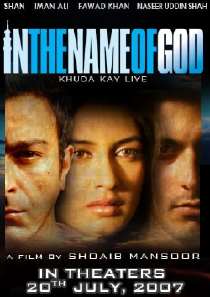 The first is about India and Pakistan. For the first time in a long time, a Pakistani produced film is being shown commercially in India and it's making big news. Pakistanis have always been big on Bollywood but this could be an important step in improving our relations with our neighbors. It is interesting to note the power of the arts in bringing people together. Just last month, the New York Philharmonic went to North Korea and also helped the US build a new bridge with an enemy nation... I wanna see this movie!!! http://www.nytimes.com/2008/04/16/world/asia/16india.html?_r=1&ref=world&oref=slogin


